
A University of Granada study traces Spain’s cannabis social clubs from 1990s activism to judicial closure, with lessons for Tenerife’s private associations.

A University of Granada study has reconstructed the rise and decline of Spain’s cannabis social clubs through 289 court decisions issued between 1997 and 2025, tracing a national experiment whose legal room was progressively narrowed by Spain’s Supreme Court and Constitutional Court. For Tenerife and the wider province, the study offers important national context: cannabis social clubs are private, members-only, non-profit associations under Spanish law, not shops, dispensaries or public venues.
The club model began as a legal and social experiment
The University of Granada study summarized by lasDrogas.info describes the cannabis social club as a product of Spain’s legal ambiguity and organised activism. The first associations emerged during the 1990s among people who consumed cannabis and were seeking a community-based alternative to the illicit market. Their stated model was non-profit, collective and based on self-cultivation rather than commercial retail.
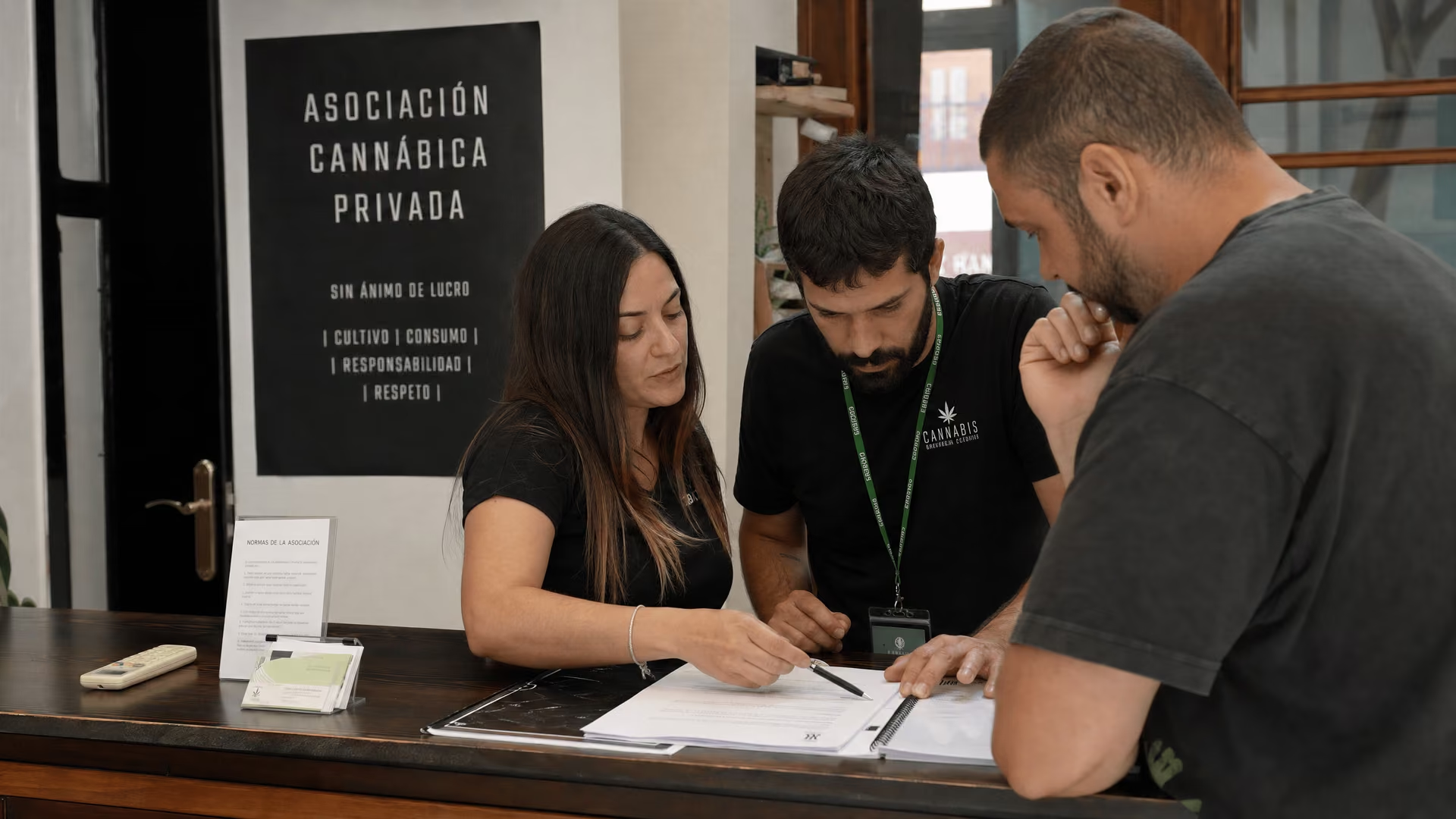
That distinction remains essential in Tenerife. A social club is a private association whose membership is governed by the individual organisation; it is not an open-to-the-public business. Visitors do not acquire membership simply by arriving in Tenerife, and the national history of the clubs should not be read as a general invitation or guarantee of access.
The original model rested on several linked premises:
- People who consumed cannabis organised themselves through associations rather than commercial shops.
- Cultivation was conceived collectively and without a profit motive.
- The association served a closed group of members rather than the general public.
- The model sought to distinguish shared consumption within a defined group from trafficking or commercial supply.
The study presents the clubs not as a straightforward legalisation project, but as a form of policy contestation. Activists, regional institutions, prosecutors and courts repeatedly tested the boundary between private collective activity and conduct that Spain’s criminal law treated as facilitation or trafficking.
A neutral view of the model also requires acknowledging its limits. The associations did not receive a single, comprehensive national law setting out a stable operating framework. Instead, their room for action developed through legal interpretations, regional approaches and court decisions that could differ over time.
The association model is therefore best understood through its institutional features rather than through a retail comparison:
A legal grey zone opened the way for expansion
The study traces the opening of this grey zone to changes in Spain’s legal framework during the 1980s. The 1983 reform of the Spanish Penal Code differentiated cannabis from substances treated as more serious, while leaving consumption itself outside criminal punishment. At the same time, trafficking and facilitation remained punishable.
That combination created uncertainty around self-consumption and collective consumption. Associations such as ARSEC in Barcelona used collective cultivation as a way of pressing the courts to clarify the boundary. The resulting case law was inconsistent during the 1990s, with both convictions and acquittals, but a doctrine of “shared consumption” gradually developed. It distinguished trafficking from non-profit supply among a closed group of people who consumed cannabis.
The main milestones in that development were:
The Basque Country became the most stable regional setting during the period from 2002 to 2011. The study describes associations such as Kalamudia fragmenting strategically into smaller groups in response to jurisprudence. In 2003, the Federation of Cannabis Associations, known as FAC, was created to coordinate legal strategies and encourage self-regulation.
The approach of Basque institutions was also significant. They adopted a more dialoguing attitude, supported research and facilitated public debate. The authors describe the result as the creation of temporary zones of tolerance: spaces in which clubs could operate for a time, but without the certainty of a permanent national settlement.
The 2011 ENCOD code formalised principles associated with the movement, including non-profit operation and harm-reduction aims. Yet a code of conduct could not replace legislation. The clubs remained dependent on how prosecutors, regional authorities and courts interpreted the existing framework.
Catalonia accelerated the movement and exposed its scale
The sharpest expansion came from 2012 onwards in Catalonia, especially in Barcelona. The study records 72 new associations registered in Catalonia in 2012, followed by substantial increases in 2013 and 2014. By the end of the decade, the national total had reached an estimated 800 to 1,000 clubs.
The growth was not uniform across Spain. Catalonia overtook the Basque Country by a wide margin in associations registered per 100,000 inhabitants, while the Basque model had developed earlier through a more cautious combination of association strategies and institutional dialogue. The contrast helps explain why the national movement could appear both established and legally unsettled at the same time.
The regional contrast described by the study can be summarised as follows:
| Period | Main location | Development recorded by the study | Source |
|---|---|---|---|
| 1990s | Barcelona and wider Spain | ARSEC and other activists promoted collective cultivation, while courts issued contradictory convictions and acquittals. | University of Granada study on the rise and decline of Spanish clubs |
| 2002–2011 | Basque Country | The club model consolidated more steadily; Kalamudia adapted its structure and FAC later coordinated legal and self-regulatory strategies. | University of Granada study on the rise and decline of Spanish clubs |
| 2012–late 2010s | Catalonia and Spain | Catalonia recorded 72 new associations in 2012 and strong growth in the following two years; Spain reached an estimated 800–1,000 clubs by the end of the decade. | University of Granada study on the rise and decline of Spanish clubs |
The study’s central figures show both the breadth of the expansion and the scale of the legal record examined:
Those numbers should not be treated as evidence of a regulated national market. They describe the expansion of associations operating within a contested legal environment. The growth of registrations did not resolve the underlying question of where private collective activity ended and prohibited supply began.
The Catalan experience also made the movement more visible. As the number of associations rose rapidly, the model became harder to treat as a small-scale legal experiment. That visibility placed greater pressure on courts and public authorities to define whether the existing doctrine could support a large and varied network of clubs.
The expansion is best represented through the administrative footprint it created:

The courts progressively narrowed the space
The decline described by the study was not caused by one isolated administrative decision. It emerged through a progressive tightening of judicial interpretation. The authors combine academic literature, movement documents, legislative debates and a corpus of 289 judicial resolutions to show how the ambiguous space was gradually closed by Spain’s Supreme Court and Constitutional Court.
The process matters because the club model had always depended on distinctions that were narrow and fact-specific. A closed association, collective cultivation and non-profit distribution could be treated differently from trafficking, but the distinction required authorities and courts to examine how each organisation actually operated. Expansion increased the number of cases in which those distinctions had to be tested.
The authors describe the earlier regional arrangements as “temporary zones of tolerance”.
University of Granada study
The study identifies several forces that shaped the rise and subsequent decline:
- Activists used association structures and collective cultivation to challenge the boundaries of criminal law.
- Regional institutions adopted different levels of dialogue, research support and public engagement.
- Prosecutors and courts assessed whether individual clubs remained within the logic of shared consumption.
- Federations and activists promoted self-regulation, but voluntary codes did not create a national statutory framework.
- Later decisions by Spain’s Supreme Court and Constitutional Court reduced the legal room that had enabled the movement to expand.
This explains why the word “decline” should not be read simply as a fall in public interest. It refers to the weakening of the legal and institutional conditions that had allowed the clubs to develop. A movement can remain socially visible while losing the judicial protection and administrative tolerance on which its operating model depended.
For readers in Tenerife, the important point is that the Spanish framework was never a general retail authorisation. The national case law concerned the limits of private association and shared consumption. It did not turn clubs into open dispensaries, and it did not establish that membership is available to anyone who travels to an island or another Spanish region.
The legal record is most clearly visualised as an archive of contested boundaries:

What Spain’s trajectory means for Tenerife
Tenerife’s relevance to this national history is primarily legal and institutional. The supplied study does not provide a current count of clubs on the island, a Tenerife-specific ruling or an island-wide register. It would therefore be inaccurate to use the national estimate of 800 to 1,000 clubs as a figure for Tenerife or to claim that the island followed precisely the same path as Catalonia or the Basque Country.
What can be said is more limited but more useful. Any private cannabis association in Tenerife sits within Spain’s national legal framework and must be understood through the same distinction between a members-only, non-profit association and an open commercial outlet. Each association determines its own membership arrangements, and being a resident or visitor does not itself create a right of entry.
Recent enforcement reporting elsewhere in Spain illustrates why that distinction remains operational rather than merely theoretical. Authorities in Carmona ordered the precautionary closure of a cannabis club on 23 July 2026 after detecting serious deficiencies and cannabis whose origin was not accredited, according to a report on the Carmona closure. That case is not evidence about Tenerife, but it shows how local authorities may intervene when an association’s operation raises regulatory or evidential concerns.
The national study also helps explain why local debates can be difficult to resolve. Spain’s club movement grew through decentralised governance, regional variation and judicial interpretation rather than through one clear national statute. The result was a framework in which the same broad association principles could be discussed very differently by activists, municipalities, prosecutors and courts.
For Tenerife residents and international visitors, the practical questions are therefore narrower than the language of a cannabis “club” can suggest:
What the Spanish club model does and does not establish
Are cannabis social clubs shops or dispensaries?
No. The model described by the study is based on private, members-only, non-profit associations rather than open commercial retail.
Does travelling to Tenerife automatically provide club membership?
No. Membership is a private matter decided by each association. Arrival in Tenerife or another Spanish region does not itself create access.
How many cannabis social clubs are there in Tenerife?
The supplied study does not provide a current Tenerife count or an island-wide register, so no reliable figure can be given from these facts.
What period did the University of Granada study examine?
Its judicial corpus contains 289 resolutions issued between 1997 and 2025, alongside academic, legislative and movement documentation.
Why did the national club movement decline?
The study attributes the decline to the progressive closure of the ambiguous legal space by Spain’s Supreme Court and Constitutional Court, after years of regional variation and judicial contestation.
The main points for Tenerife readers are these:
Spain’s cannabis social-club movement rose because activists and regional institutions found room to test the boundaries of the Spanish Penal Code, and declined as the courts progressively closed that room. For Tenerife, the lesson is not that a national club boom created open access, but that any private association remains tied to membership rules, non-profit principles and a legal framework shaped by continuing judicial scrutiny.
Sources
- Reducir daños del basuco exige enfrentar también la violencia (canamo.net)
- Irlanda busca destrabar el cáñamo industrial tras cultivar solo 11 hectáreas (canamo.net)
- El mercado del plátano en la Península, aún más hundido: los agricultores ya solo reciben 0,36 euros/kilo (eldiario.es)
- 'Canarias: 50 años tras la oscuridad': La Reparación (eldiario.es)
- Canarias registra un 30% de muertes por ahogamientos en 2026 (abc.es)
- La Universidad de La Laguna detecta acumulación de radón en varios de sus edificios (abc.es)
- Una asociación que teme desaparecer tras 13 años de lucha y ante un cierre inminente (eldiarioalerta.com)
- Clausuran un club de cannabis en Carmona por graves deficiencias y droga sin origen acreditado (diarioavanza.es)
- Auge y declive de los clubes sociales de cannabis en España (lasdrogas.info)
- Seis detenidos en Dénia al desmantelar un club cannábico donde presuntamente vendían drogas (europapress.es)